Getting the Daily Standup Back to Its Purpose
How daily standups drift from quick team syncs into status reports, and practical ways to bring them back
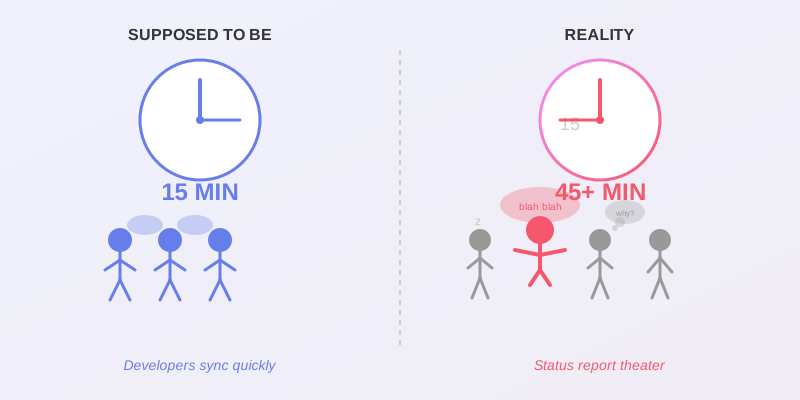
Over time I’ve watched standups drift from a quick team sync into something else. Here’s what I think happened, and how to fix it.
If you’re a developer, chances are you’ve sat through a 30-minute “standup” where managers asked probing questions, product owners gave detailed updates, and the actual developers wondered why they’re there. Sound familiar?
The standup meeting, originally designed as a quick 15-minute developer sync, has morphed into something it was never meant to be. Let me explain what went wrong and what we can do about it.
What Standups Were Supposed To Be
The original concept was beautifully simple:
Purpose: “How are things going toward our sprint goal, and what needs to be adjusted?”
Duration: 15 minutes maximum—literally short enough to stand the entire time without discomfort
Participants: The development team talking to each other
Format: Three questions per person:
- What did I do yesterday?
- What will I do today?
- What’s blocking me?
That’s it. No deep dives. No problem-solving. No status reports to management. Just a quick team sync to stay aligned on sprint progress.
What Standups Have Become
Fast forward to today, and most standups look nothing like this. Here’s what I see regularly:
Duration: 30 minutes scheduled, sometimes running over
Participants: Developers, QA, product owners, engineering managers, sometimes multiple managers
Reality:
- Product owners giving detailed updates about roadmap items
- Managers asking clarifying questions about estimates and timelines
- Deep technical discussions that should happen offline
- Detailed explanations of implementation approaches
- Observers pulling the meeting into their own topics
- Developers performing status theater instead of collaborating
The meeting has become performative. When management is in the room, it inevitably transforms into a status report rather than a team coordination tool.
The Problem with Management in Standups
Here’s what I’ve come to believe: standups work best when managers and product owners mostly listen and save their questions for afterward.
Here’s why:
When a manager is present, the dynamic fundamentally changes. Developers stop talking to each other and start reporting up. The natural human instinct is to demonstrate productivity and justify time spent. What should be a quick “I’m working on the login bug, need help from Sarah on the API” becomes “Well, I investigated three different approaches to the authentication flow, considered the security implications, reviewed the OAuth2 spec, and I’m currently implementing the token refresh logic with proper error handling…”
The meeting becomes theater.
What a Healthy Standup Actually Looks Like
A healthy standup dynamic should look like this:
Developers talk to developers - The team coordinates their work, identifies dependencies, and asks for help
QA raises test-related blockers early - “Can’t test feature X until the staging environment is fixed”
Product Owner listens for scope or priority risks - Not speaking unless there’s a critical priority shift
Manager listens for systemic issues - Not speaking unless there’s a pattern that needs addressing
No one interrupts. No one solves problems. No one has “just a quick follow-up.”
The standup identifies issues. Solving those issues happens after the standup in smaller groups with only the relevant people.
Why This Matters
You might be thinking, “What’s the big deal? So standups run long—that’s just how meetings are.”
But here’s the thing: developers don’t find value in these meetings.
When I’ve asked developers across teams I’ve worked on, a common answer is that standups feel like status reporting rather than coordination. The people getting the most value tend to be the ones collecting status, not the ones doing the work.
When developers don’t find value in a core agile ceremony, that’s a huge red flag. It means we’ve broken the fundamental social contract of standups: this is the team’s meeting to coordinate work, not management’s meeting to track progress.
The Performance Trap
The longer standups run and the more management is involved, the more they become performative. Developers learn that the meeting isn’t about actual coordination—it’s about demonstrating productivity.
So they prepare. They think about what to say. They elaborate on work that doesn’t need elaboration. They avoid saying “I’m stuck” because that might look bad. They spend cognitive energy on meeting performance instead of solving problems.
This is the opposite of what standups were designed to do.
Practical Fixes
If you recognize this problem in your team, here are some ways to fix it:
1. Declare the standup “for the delivery team”
Make it explicit that this meeting is for developers, QA, and anyone directly building the product to coordinate work.
2. Invite others as optional observers
Product owners and managers can attend, but set the expectation that they’re there to listen, not participate.
3. Make it strictly timeboxed
15 minutes. Hard stop. Use a timer. If discussions need to happen, they happen after as separate conversations with only relevant people.
4. Keep the floor with the delivery team
Politely but firmly redirect the meeting if non-developers start discussing, problem-solving, or asking detailed questions during standup.
5. Move deep discussions offline
If someone starts explaining implementation details, interrupt kindly: “Let’s take that offline with just the people working on that feature.”
6. Change the question format
Instead of “What did you do yesterday?”, try:
- “What’s our progress toward the sprint goal?”
- “What needs adjustment?”
- “Who needs help from the team?”
This shifts from individual status reports to team coordination.
7. Give status its own channel
Managers and product owners genuinely need status information. They should get it from a better channel than the standup: a well-maintained board, a short async update, or a separate sync. The goal isn’t to shut anyone out; it’s to use the right tool for each job.
The Root Cause
Standups fail when they become performative. The more people with power in the room, the more likely that happens.
The solution isn’t to abandon standups—it’s to return them to their original purpose: a quick team sync for the people actually building the product.
Keep it small. Keep it focused. And let the real conversations happen somewhere else, where they belong.
A Call to Action
If you’re a developer frustrated with your standups, you’re not alone. If you’re a manager or product owner, I’m not saying you don’t care about the team—I’m saying your presence changes the dynamics in ways that hurt the meeting’s effectiveness.
The best standup is one where:
- Developers feel safe saying “I’m stuck”
- The team coordinates quickly without performance anxiety
- Real problems get flagged for follow-up, not solved in the moment
- Everyone leaves after 15 minutes to get back to work
Anything else? That’s not a standup. That’s a status meeting pretending to be agile.
Final Thoughts
Standups were created with good intentions. They were meant to keep distributed teams aligned, surface blockers early, and maintain momentum toward sprint goals.
But somewhere along the way, we forgot the core principle: this is the team’s meeting.
When we let standups become status reports for management or problem-solving workshops that span 30+ minutes, we’ve lost the plot. We’ve traded a valuable coordination tool for yet another meeting that developers tolerate rather than value.
It’s time to reset. Keep standups short, focused, and for the people building the product. Everything else can happen elsewhere.
What do your standups look like? Are your developers finding value, or are they just going through the motions? I’d love to hear your experiences—the good, the bad, and the painfully relatable.